Files are not syncing or sync is paused
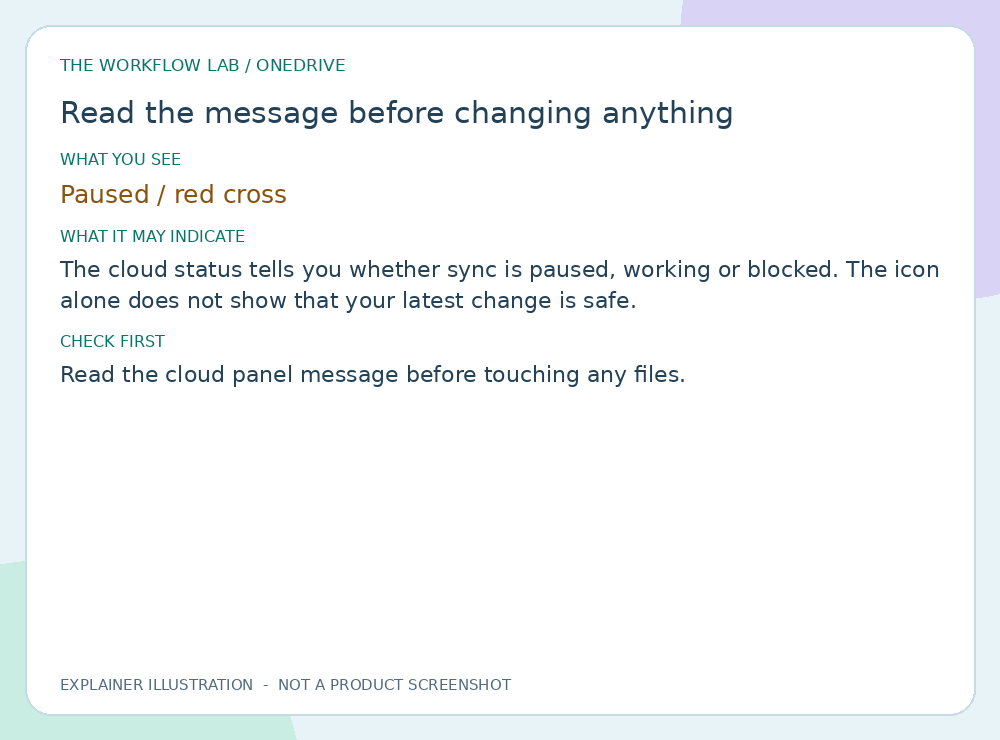
Read the cloud panel message before touching any files.
Applies to: OneDrive on Windows or macOS.
Revision 5 · 18 November 2026 · General first-line guidance. Wording varies by version; a symptom is not a confirmed diagnosis.
What does the message mean?
Some rows describe a visible symptom rather than an exact message. Wording marked “varies” may differ on your screen.
| What you see | What it may indicate | What to check |
|---|---|---|
| Paused / red cross | The cloud status tells you whether sync is paused, working or blocked. The icon alone does not show that your latest change is safe. | Read the cloud panel message before touching any files. |
| Paused symbol | OneDrive is not currently syncing. This is a status, not proof of an error. | If paused and you are allowed to, choose Resume syncing once and watch for progress. |
| Red cross | A file or folder cannot sync. The panel message gives the reason. | Read the exact message. Do not delete the file to clear the icon. |
| Circular arrows | OneDrive is processing or transferring. Long activity alone is not a fault. | Watch whether progress changes. Keep the device connected. |
| Storage full / account attention (wording varies) | A quota or account issue may block syncing. | Record the full message and ask IT; do not delete work to make space. |
| No message at all | Problems can happen without any message. A blank screen or a missing control is still useful evidence. | Record the visible behaviour, the time and who is affected. Do not guess a code. |
Step-by-step checks
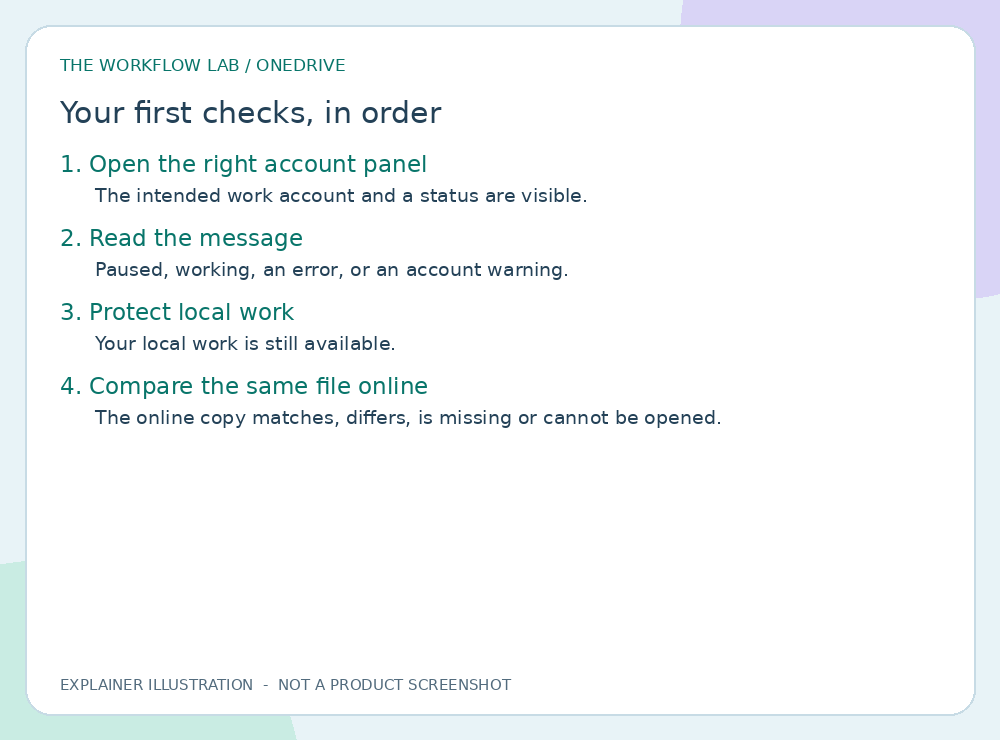
Work in order and stop when it is resolved. If your screen differs, note what is different and ask IT or the owner.
Open the right account panel
- Do this
- Select the OneDrive cloud icon in the notification area or Mac menu bar and check the account name.
- What you should see
- The intended work account and a status are visible.
- Then what?
- If the account or setup looks unfamiliar, stop and ask IT. Do not relink accounts.
Read the message
- Do this
- Read the full message and any file named in it.
- What you should see
- Paused, working, an error, or an account warning.
- Then what?
- Resume an ordinary pause only if permitted. Record errors. Do not delete the file.
Protect local work
- Do this
- Leave local files where they are. Do not move or delete folders to clear a warning.
- What you should see
- Your local work is still available.
- Then what?
- If work may not be uploaded, tell IT before any reset, unlink or folder change.
Compare the same file online
- Do this
- If permitted, view the same file in your normal work OneDrive on the web without editing both copies.
- What you should see
- The online copy matches, differs, is missing or cannot be opened.
- Then what?
- If different or uncertain, stop and ask IT. A timestamp alone does not prove which version is right.
When to stop and contact IT or the owner
- Work could be lost, or you cannot tell which version is current.
- The problem repeats, or a managed setting blocks you.
- A step would change production data, shared connections, permissions or security.
What to put in your support request
The app and version if visible, your device, the time, the exact message, who is affected, and the checks you tried with what you saw. Remove names, addresses and confidential content from screenshots. Never send passwords or MFA codes.
Microsoft reference
Microsoft documentation for this topic (opens a new tab). Some links are product hubs. Official pages may include advanced steps; ask IT before applying them on a managed device.
Related guides
Was this guide helpful? Leave feedback
Tell us what worked, what was unclear, or what is missing. Feedback is private and goes to The Workflow Lab for review. It is not shown publicly and is not an IT support request.
The Workflow Lab is independent of Microsoft and is not your employer’s service desk.