Understand a PowerShell error before retrying
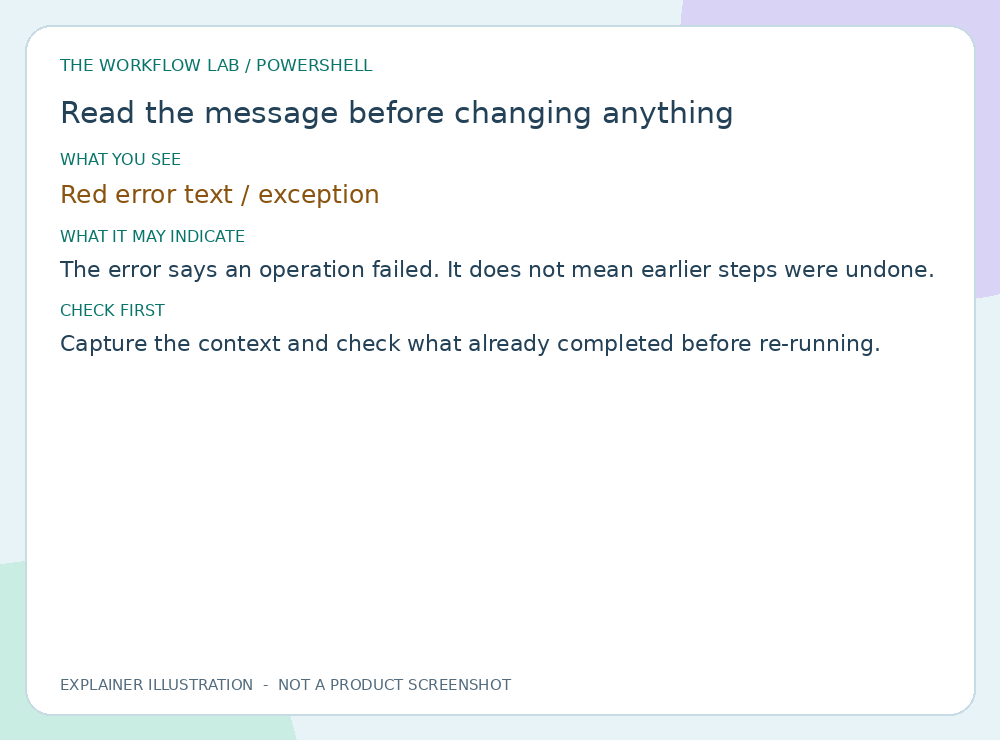
Capture the context and check what already completed before re-running.
Applies to: Windows PowerShell and PowerShell 7 differ. Only read-only inspection is suggested.
Revision 5 · 18 November 2026 · General first-line guidance. Wording varies by version; a symptom is not a confirmed diagnosis.
What does the message mean?
Some rows describe a visible symptom rather than an exact message. Wording marked “varies” may differ on your screen.
| What you see | What it may indicate | What to check |
|---|---|---|
| Red error text / exception | The error says an operation failed. It does not mean earlier steps were undone. | Capture the context and check what already completed before re-running. |
| No message at all | Problems can happen without any message. A blank screen or a missing control is still useful evidence. | Record the visible behaviour, the time and who is affected. Do not guess a code. |
Step-by-step checks
Work in order and stop when it is resolved. If your screen differs, note what is different and ask IT or the owner.
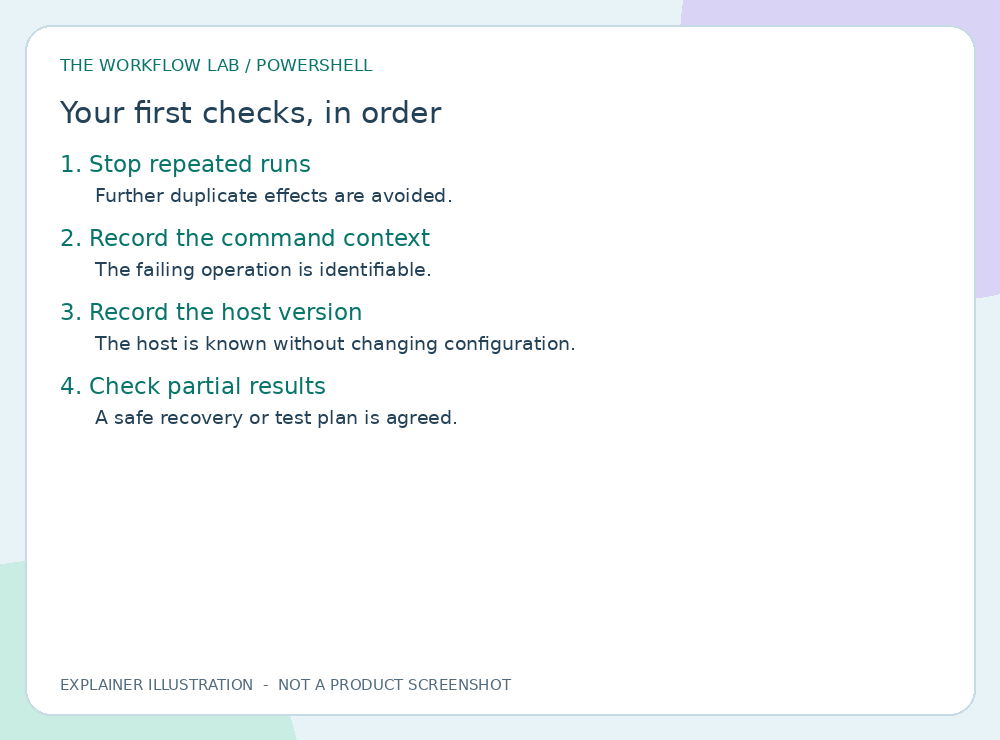
Stop repeated runs
- Do this
- Do not re-run a script that creates, updates or deletes things.
- What you should see
- Further duplicate effects are avoided.
- Then what?
- If this explains what you see, record it and continue only if the next check still applies.
Record the command context
- Do this
- Note the script name, the failing command and the line shown, with secrets removed.
- What you should see
- The failing operation is identifiable.
- Then what?
- Record the result without changing settings. Stop if work, data or security could be affected.
Record the host version
- Do this
- If permitted, run the read-only $PSVersionTable and note the edition and version.
- What you should see
- The host is known without changing configuration.
- Then what?
- Use only the approved action described here. If it does not match your screen, stop and ask IT.
Check partial results
- Do this
- Ask the script owner what already completed.
- What you should see
- A safe recovery or test plan is agreed.
- Then what?
- If unresolved, contact IT or the owner with sanitised evidence. Do not repeat actions that could duplicate data.
When to stop and contact IT or the owner
- Work could be lost, or you cannot tell which version is current.
- The problem repeats, or a managed setting blocks you.
- A step would change production data, shared connections, permissions or security.
What to put in your support request
The app and version if visible, your device, the time, the exact message, who is affected, and the checks you tried with what you saw. Remove names, addresses and confidential content from screenshots. Never send passwords or MFA codes.
Microsoft reference
Microsoft documentation for this topic (opens a new tab). Some links are product hubs. Official pages may include advanced steps; ask IT before applying them on a managed device.
Related guides
Was this guide helpful? Leave feedback
Tell us what worked, what was unclear, or what is missing. Feedback is private and goes to The Workflow Lab for review. It is not shown publicly and is not an IT support request.
The Workflow Lab is independent of Microsoft and is not your employer’s service desk.